Dive into the world of virtual research environments as John Bell and Nicola Camerlenghi bring St. Paul’s Basilica back to life!
Virtual Research Environments: Re-Making St. Paul’s Basilica
12:00PM-1:30PM, November 4, 2026
Kreindler Seminar Room
031 Haldeman Center
Open to all attendees
Lunch will be available
Sign up at: https://dartgo.org/vre-basilica
Join John Bell (Film and Media Studies, DREAM Studio) and Nicola Camerlenghi (Art History) as they discuss their eight-year collaboration to produce a virtual research environment for study of architecture and art history.
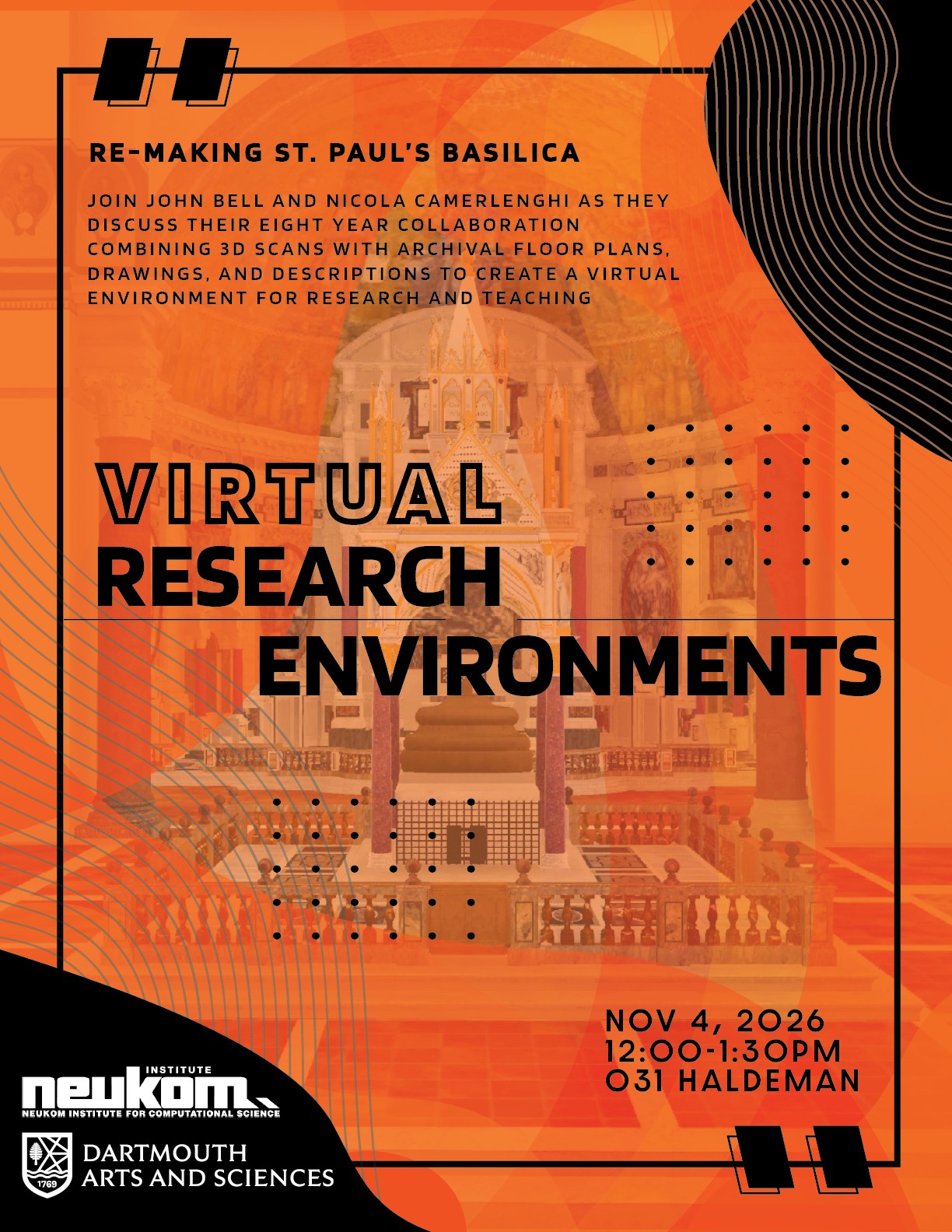
Virtual Basilica is a soon-to-be-released desktop and virtual reality app dedicated to one of Rome’s most venerable buildings, the Basilica of St. Paul. Built in the late fourth century to enshrine the tomb of the apostle, it was the last and largest of the imperial basilicas in Rome, surviving until a devastating fire in 1823. Virtual Basilica is based on archival documents, historical images, archaeological excavations, and 3D scans taken from the existing replica of the building, built after 1823. The app permits users to explore what St. Paul’s looked like just prior to the time of the fire, as well as at key points in its sixteen-hundred-year history.
Bell and Camerlenghi will talk about the process of digitizing and communicating changes in space and appearance over time, as well as what to do when the historical record is not clear. The decisions made to produce a virtual environment for an Open Educational Resource (OER) intended for students and scholars are much more complex than just building a 3D model. Through the singular instance of St. Paul’s, Virtual Basilica shows how long-lived buildings can anchor memory and meaning across centuries, persisting precisely because they change with the times.
Teacher plans and student exercises are offered in conjunction with the app. As an educational resource, the visualization of the building is supported by a database of source information, and clearly differentiates documented features from those based on informed speculation.
The project was funded by the National Endowment for the Humanities, the Mellon Foundation, the Kress Foundation, as well as by grants from Dartmouth and Smith Colleges.
